Sub-Zero Refrigerator Repair
Gaggenau vs Sub-Zero Refrigerator: Build, Cooling and Upkeep
Choose Sub-Zero for separate cooling in combination units and widely stocked US parts; choose Gaggenau for flush European columns with steel interiors. Both hold food well, so the real gap is in how each is built, ventilated and serviced over the years.
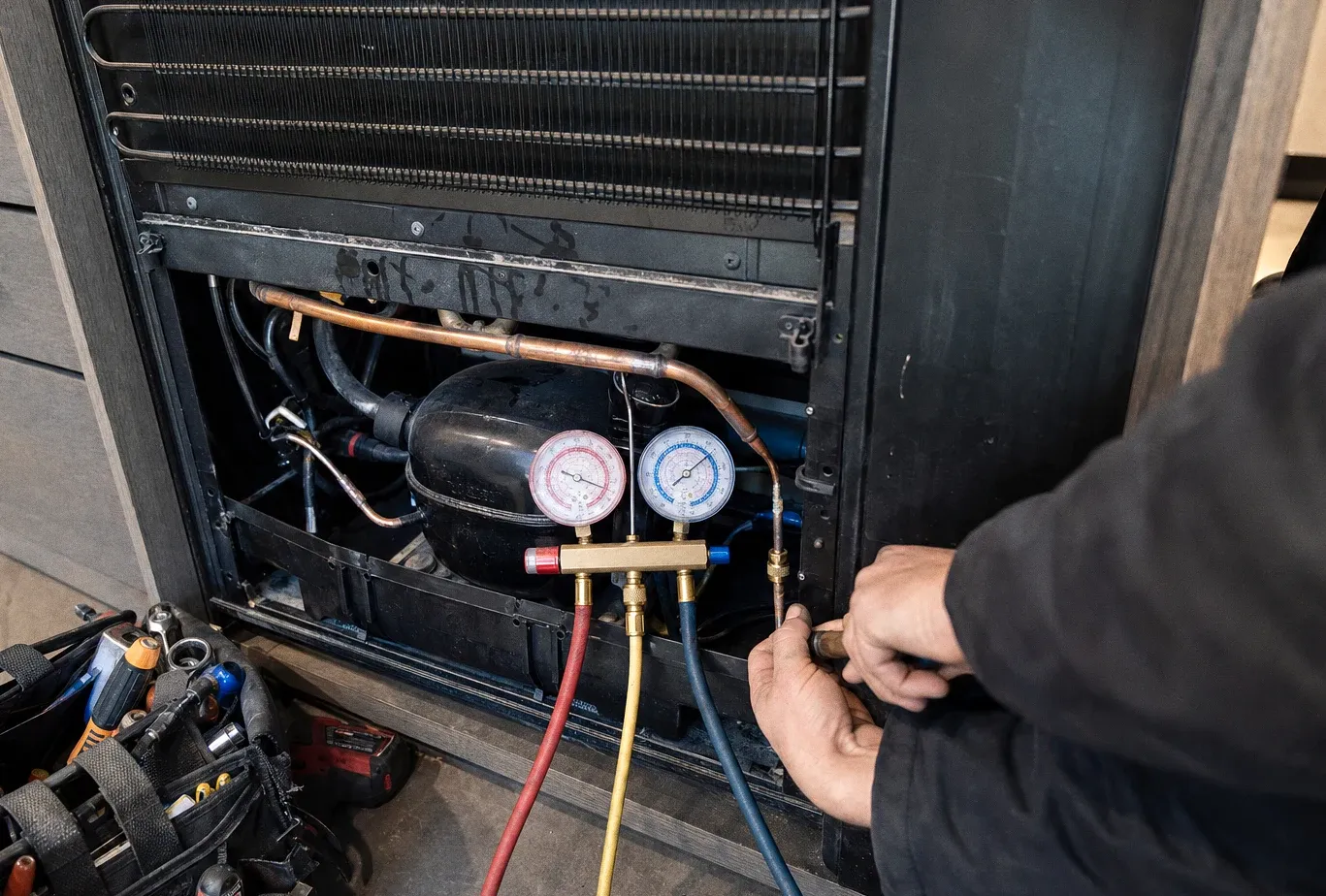
For most owners the answer is this: pick Sub-Zero if you want a refrigeration specialist whose over-under and side-by-side built-ins give the fresh-food and freezer sections separate cooling, backed by parts that are widely stocked in the United States; pick Gaggenau if you want flush, fully integrated European columns with stainless steel interiors that line up into one seamless wall. Either brand will hold a fresh-food compartment near 37°F and a freezer at 0°F without drama. What separates them after the first year is construction, the way each one divides the cold, which parts wear first, and how quickly a technician can get a stalled unit back to temperature.
That last point weighs more in a city kitchen. In a Beacon Hill rowhouse or a South End condominium, a built-in is usually boxed tight into cabinetry, and sliding it out is a project in itself, so most repairs happen right where the unit stands.
How the two are built
Sub-Zero makes refrigeration and nothing else, and its built-ins feel like it. The classic models put the compressor and condenser in a compartment above the doors, behind a louvered panel you can lift off, which keeps the coil within easy reach for cleaning. The integrated columns hide the machinery behind custom panels so the unit disappears into the cabinetry.
Gaggenau belongs to the BSH group, the same parent as Bosch and Thermador, and it starts from a European design brief. Its Vario columns are made to sit perfectly flush beside one another, with stainless steel interior walls and aluminum trim that look closer to architecture than to an appliance. Every column is a complete machine, so a refrigerator, a freezer and a wine cabinet can be set side by side to form one continuous face of steel or panels.
The difference is mostly feel: Sub-Zero leans toward heavy, practical solidity, while Gaggenau leans toward precise, minimal surfaces where each seam matches the next.
How each one divides the cold
Sub-Zero’s signature is dual refrigeration. In its combination built-ins, the fresh-food side and the freezer get their own cooling, so dry freezer air never sweeps across the produce and freezer smells stay out of the butter dish. The fresh-food section keeps more humidity, which slows wilting. Many models also carry an air purification cartridge, swapped about once a year, that strips odors and ethylene from the compartment.
Gaggenau gets a similar result through layout. A Vario installation is normally a set of separate columns, each with its own compressor and evaporator, so the refrigerator and freezer never share air at all. The trade-off is that a three-column wall means three sets of machinery that can each need a visit.
Sub-Zero columns work the same way, so column against column the cooling story is close to even. The real split appears in single-cabinet combination units, where Sub-Zero still keeps each compartment on its own cooling.
What tends to wear out
On both brands, the faults cluster around the same handful of parts. Door gaskets flatten or split, and a leaking seal shows up as frost on the freezer walls or beads of water on the door frame. Evaporator and condenser fans slow down or seize, so the box drifts warm while the compressor keeps running. Defrost heaters, thermostats and sensors fail, and ice builds up on the coil until air cannot pass. Ice makers jam at the fill tube or lose their water valve. Control boards fail less often but cost the most of the routine repairs.
A condenser coated in lint and kitchen grease makes any refrigerator run longer and hotter, and on a Sub-Zero classic model a few minutes with a soft brush every few months heads off a lot of trouble. Integrated columns from either maker need their intake vent left clear, so do not park a basket or a rug against it. If your cubes have gone cloudy or hollow, our note on reading the shape of Sub-Zero ice explains what each one points to.
For Sub-Zero work, typical figures are $280–$800 for a door gasket, $300–$590 for a fan motor, $290–$730 for a defrost heater, thermostat or sensor, $290–$670 for an ice maker or water valve, $520–$950 for an electronic control board and $1,010–$2,090 for compressor or sealed-system repair. Those are typical bands; the firm number comes after the fault is diagnosed.
Service and parts around Boston
Here the two brands differ most. Sub-Zero builds its refrigeration in the United States and keeps parts widely stocked, so a gasket, fan or valve is usually a short order rather than a long wait. Gaggenau parts move through the BSH network, and while common pieces are easy to get, a less common column part can take longer to arrive. Before buying either, ask a local service company whether it works on that brand and how it sources parts.
Installation matters as much as the name on the door. A column squeezed into an opening with no room to breathe will run hot whatever it says on the badge, and a custom panel heavier than the hinge was built for will sag and break the seal. In older buildings, confirm that a dedicated circuit and a water line reach the spot cleanly before delivery day.
Sub-Zero Repair Boston is an independent shop that uses factory-approved parts and handles Sub-Zero refrigerator repair along with freezers, ice makers and wine storage in Beacon Hill, the South End, the North End and Medford. A visit begins with a flat $95 charge for the trip and a full diagnosis, and that $95 is taken off the repair when you give the go-ahead. Call (781) 675-1098 to set a time.
Which one fits your kitchen
Choose Sub-Zero if the refrigerator is the appliance you care most about, if you want an over-under or side-by-side with separate cooling for each compartment, or if fast access to parts matters more to you than matching trim.
Choose Gaggenau if you are planning a wall of matching columns, if the rest of the kitchen already carries that name and you want one design language, or if stainless interiors and flush European lines are the whole point.
If you already own a working Sub-Zero and are tempted to switch, cost it out honestly. A new built-in plus fresh panels and a reworked cutout costs many times what even sealed-system work on the existing unit does. A tired gasket or a noisy fan is rarely a reason to retire a cabinet that is otherwise sound.
Still asked on the phone
Is Gaggenau more reliable than Sub-Zero?
Neither brand is clearly more reliable; both are premium built-ins whose faults land on the same few parts. Door gaskets, fan motors, defrost components, ice makers and control boards account for most service visits on either one. How the unit was installed, whether it has room to breathe and how often its condenser gets cleaned matter more than the badge.
Do Sub-Zero and Gaggenau columns fit the same cabinet openings?
Not interchangeably, so plan on some cabinet work if you switch brands. Each maker publishes its own cutout sizes, hinge clearances and panel specifications, and a fraction of an inch decides whether a panel sits flush. Get the installation guide for the exact model before ordering cabinetry or a replacement.
What does a Sub-Zero repair visit cost in Boston?
The visit itself is a flat $95, which pays for the trip and a complete diagnosis and is credited toward the repair once you approve it. Typical repairs run from $280–$800 for a door gasket up to $1,010–$2,090 for compressor or sealed-system work, with the firm price given after the fault is found.
Should I repair an aging Sub-Zero or replace it with a Gaggenau?
Repair is usually the better buy unless the sealed system has failed and the cabinet is worn out. A comparable new built-in, with panels and cutout changes, costs many times more than most repairs. Get the diagnosis first, then weigh the quote against the age and condition of the unit.