Sub-Zero Refrigerator Repair
Where to Find the Model Number on a Sub-Zero Refrigerator
On most built-in Sub-Zero refrigerators the model number is printed on the serial tag inside the refrigerator door, up near the top hinge; column, drawer and undercounter units keep it inside a drawer or on a cabinet wall. Here is where to look and how to read it.
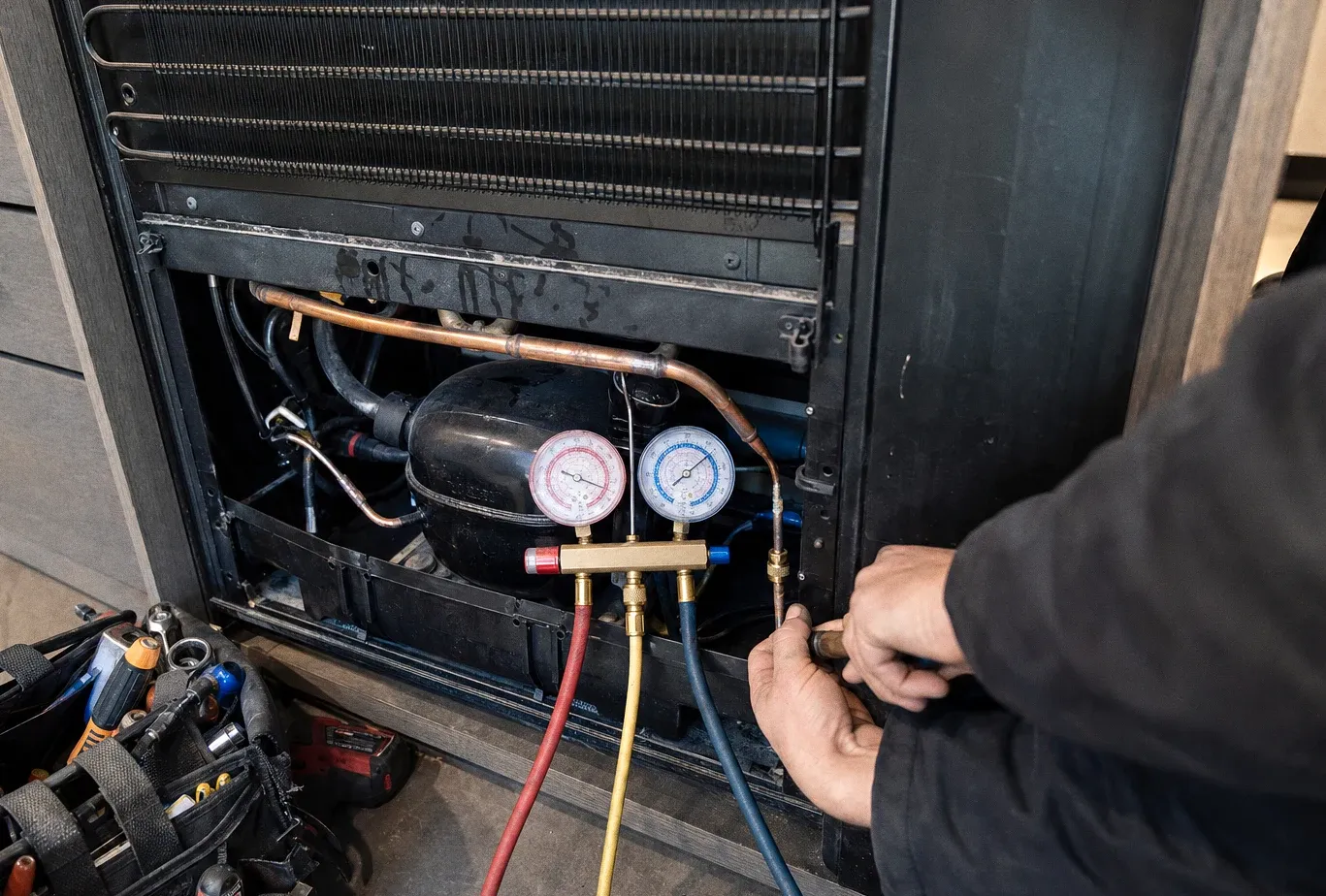
Open the refrigerator door and look along the inside edge, up near the top hinge. On most built-in Sub-Zero over-and-under models that is where the serial tag sits, and it holds the model number, the serial number and the date the unit was made. Column, drawer and undercounter units keep the tag lower down, inside a drawer or on a cabinet wall. With a flashlight it takes about a minute, and a sharp phone photo of that tag is the most useful thing you can have ready before booking a repair.
Built-in refrigeration makes this harder than it sounds. A panel-ready column behind custom cabinet doors may show no badge at all from the front, and in a Beacon Hill townhouse or South End condo bought with the refrigerator already fitted, the original paperwork has often gone with the previous owner. The tag is the one record that stays with the machine, and the series it names decides which parts will fit.
Where Sub-Zero puts the tag on each design
The location follows the way the cabinet opens. Find the line that matches your unit and look there first.
| Your refrigerator | Where to look |
|---|---|
| Over-and-under: Classic (BI, CL), 600, 500 and 200/300 Series | Inside the refrigerator door, close to the top hinge |
| Side-by-side | Inside the freezer door |
| Classic French-door | Inside the left-hand door |
| Designer Column (IC, DEC) | Middle drawer, beside its guide rail, opposite the hinge side |
| Designer Tall (IT, DET), Designer Drawer (ID), 700 Series | Cabinet interior, just left of the top drawer |
| PRO3650 | On the cabinet wall left of the freezer drawer |
| PRO4850 and 648PRO | Left of the upper freezer drawer |
| UC-15I and DEU1550I ice makers | On the left side wall inside |
| DEU undercounter units | On the ceiling of the cabinet |
Pull drawers out to their full travel and move a few jars if they block the view. The tag is a printed label, so wipe it gently rather than scrubbing, and never peel it off: once it is gone, every future parts order turns into guesswork. On an undercounter unit, kneel down and aim the light upward, because a tag on the cabinet ceiling faces the floor and is easy to look straight past.
When the tag will not turn up
Other refrigerators tend to follow a few habits. The label usually sits on a side wall of the fresh-food compartment, often beside or behind the crisper drawers, on the ceiling near the light, or behind the removable grille at floor level, and freestanding units sometimes carry a second sticker on the back panel. Do not trust the nameplate on the front grille: it gives the brand and sometimes the line, never the full model.
If the label has faded or been painted over during a renovation, turn to the paper trail: the use and care booklet, installation guide, sales invoice or an earlier repair invoice usually records both numbers. Failing that, the cabinet itself still says a lot.
How to read a Sub-Zero model number
A Sub-Zero model number is a short description of the machine, read from left to right. Sub-Zero’s own key turns DET3050CIID/R into a Designer, 30 inches wide, that pairs refrigerator and freezer in one cabinet, makes ice, dispenses it inside the door and swings open from the right. CL3650RA/S/P/L reads as a Classic, 36 inches wide, all-refrigerator, with a high-altitude glass door, a stainless finish, a pro handle and a left-hand hinge. Copy the whole string, slash and all, because the characters at the end separate units that otherwise look identical.
Older 200 and 300 Series combination models hide a neat trick: count the 1s in the number and you have the number of compressors and temperature controls. A 361RFD has one of each, a 3211RFD has two, and model 211 breaks the pattern with just one.
Names changed too. Since March 2019, what Sub-Zero used to call Built-In has been sold as Classic, the old Integrated line carries the Designer name, and PRO was left alone. So an old manual that says Built-In is describing the same family your Classic belongs to.
When the tag is unreadable, look at the grille. Classic (BI) units came in 30, 36, 42 and 48-inch widths with a flip-up grille across the top, whereas Designer units come in 24, 30 and 36 inches with the grille down at the bottom. Width plus grille position narrows the family quickly.
What the dates tell you about age
Every Sub-Zero tag carries a manufacture date, and the prefix confirms the era. Legacy Classic (BI) models were built from 2008 to 2022, and the current Classic (CL) line began in 2022. Designer Tall and Column units with IT and IC prefixes ran from 2014 to 2022 before DET and DEC replaced them, while Designer Drawer (ID) models are still in production. Older still, 500 Series production spanned 1987 through 2003, overlapping a 600 Series that ran 1996 through 2009.
Age feeds straight into the repair-or-replace question. A compressor or sealed-system repair on a built-in typically runs $1,010–$2,090, while a comparable new built-in refrigerator, appliance only, sits around $8,600–$21,540 before panels or installation. Those are typical bands and the firm figure comes after diagnosis, but knowing the series lets the technician check part availability for an older unit before you decide.
Why the technician asks for both numbers first
The model number narrows the parts list to one series and size; the serial number pins down the build, which matters because components can be revised partway through a model’s life. Reading both out when you phone (781) 675-1098 means the first visit can start with the right part numbers in mind rather than a second trip to fetch them.
It also prevents wasted errands. Sub-Zero names a long list of units with no internal water filter: wine storage (the IW-30CI aside), ID drawer models, UC-24 and DEU undercounter refrigeration, plus every 200/300, 500, 600 and 700 Series unit. The DEU1550I ice maker leaves the factory without one too. If your model is on that list, a slow or stalled ice maker is not a filter problem, and the supply line or fill valve is a likelier place to look; that work typically runs $290–$670. A worn door seal, another common call, is usually $280–$800.
The first step is a flat $95 service call. It buys the visit plus a full look at what has failed, and when you say yes to the work, those dollars count toward the repair total. The refrigerator repair page covers the usual faults on built-in units, and ice maker repair deals with ice that has slowed or stopped.
Still asked on the phone
Can I look up refrigerator parts by model number?
Yes, the model number is where any parts search starts, but give the serial number with it. The model tells a supplier the series, width, configuration and hinge side, while the serial number identifies the production run, and parts such as control boards or fan motors can change within one model's life. With both numbers, the part that arrives is far more likely to be the one that fits.
Is the model number the same as the serial number?
No, they are two separate lines on the same Sub-Zero tag. The model number describes the design, such as a Classic 36-inch all-refrigerator, and every unit of that kind shares it. The serial number belongs to your machine alone and ties it to the batch and date it was built.
How can I tell how old my Sub-Zero is?
Read the manufacture date on the serial tag, because Sub-Zero prints it there on every unit. The prefix makes a useful cross-check: BI models were built from 2008 to 2022 and CL models from 2022 on, while 500 Series units were made from 1987 to 2003 and 600 Series units from 1996 to 2009.
What if the tag is missing or worn off?
Go to the paperwork next, since the use and care booklet, installation documents and any earlier service invoice normally list both numbers. If none of it survives, a technician can usually identify the series from the cabinet layout, grille position and controls, then confirm the details on the visit. Once you do find the numbers, photograph them so they are never lost again.